
The History of Applied Improvisation
The Early Roots: Neva Boyd and Education Through Play
Someone recently asked me about the history of Applied Improvisation. They felt clear on the benefits of the work, but not where the field originated or how “legitimate” it was. So here’s my very brief incomplete take.
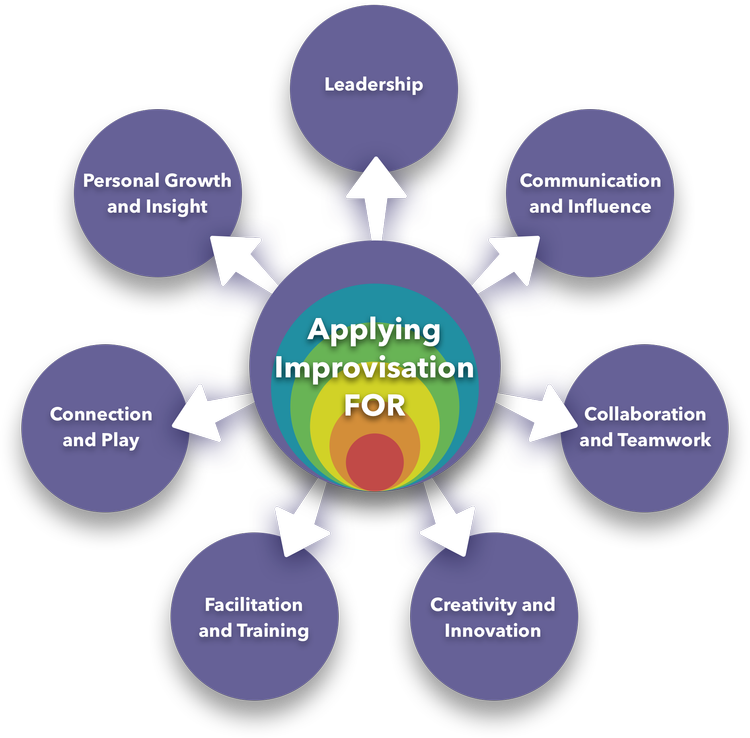
Applied Improvisation emerged from the worlds of theatre, education, and social psychology—and found its way into organizations, classrooms, healthcare, and communities seeking more human, collaborative and adaptive ways of working.
Its roots trace back to Neva Boyd, whose early 20th-century work in group games, play, and social education emphasized learning through experience, participation, and collective problem-solving. Boyd’s student, Viola Spolin, transformed these ideas into improvisational games designed not to train actors, but to unlock learning, presence, and collaboration through play.
Keith Johnstone and the Spontaneity Movement
Around the same time, Keith Johnstone was developing improvisation as a practice for understanding status, spontaneity, and creative risk-taking, in the context of performance but with a strong resistance to overly “trained” actors.
Applied Improv Enters the Workplace (1990s–2000s)
Improvisation grew as a performance art and as it did many students and teachers "rediscovered" the value of improv training beyond the stage. In the 1990s and early 2000s, facilitators began intentionally applying improvisational in organizations struggling with how to be more collaborative, creative and connected. The Applied Improvisation Network which has hundreds of global members was officially founded 2002.
The Field Today: Research, Growth, and Growing Pains
In more recent years, more rigorous academic research into the efficacy of applied improv approaches has grown. In 2021 the Boston Strategy Group published a list of references including articles, research papers and books that was 32 pages long.
As one of those practitioners who started in the ‘90’s, and an early author in the field, it has been fulfilling, fascinating and frankly sometimes frustrating to how the work has grown and developed. From a world in which the publisher of my book "Training to Imagine" (just out in its 3rd edition!) back in 2001 wouldn't let me put the word "improvisation" in the main title because he said it wouldn't sell, to a our catch phrases becoming cliche is quite a journey! Once your favorite sitcom is making a “yes, and” joke you know your ideas have become mainstream.
On the more frustrating side, these ideas and approaches can easily be bastardized and misunderstood. When held superficially, concepts like “yes, and” and “celebrate failure” can morph into less helpful, perhaps even harmful tropes.
As we enter this new year, the skills and mindsets of improvisation feel more critical than ever. So, over the next couple weeks we'll explore what these concepts really mean and how to use them well.